Ontime and Stressfree Development withMoney Back Guarantee...
Ontime and Stressfree Development withMoney Back Guarantee...
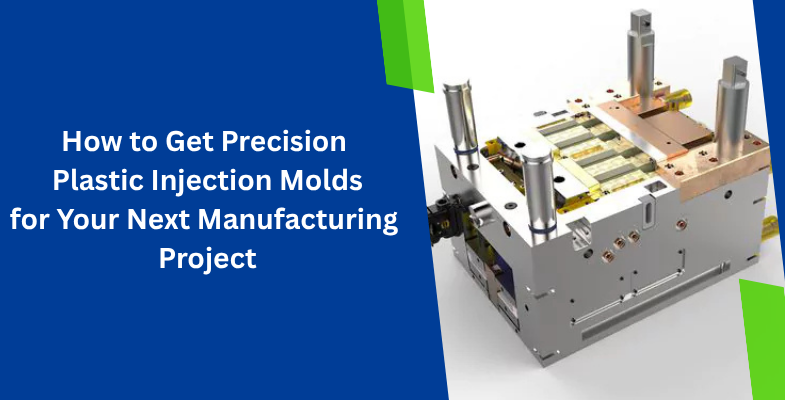
The proper plastic injection molds will run for millions of cycles without adjustment. This guide breaks down every step required to get this right. It avoids common mistakes that waste time and budget on most projects. It covers every decision point from initial design through final approval. It also explains how to evaluate and select the correct manufacturing partner.
The plastic injection molds start with a clear and complete upfront specification:

The tight tolerances require harder steel grades for long life. Their critical dimensions require dedicated independent cooling channels in the tool. The fine, small features require high precision EDM wire cutting to form.
The smooth surface finishes require skilled hand polishing after machining. Their gate placement has one of the largest impacts on final part accuracy. Ejector pin size and location directly influence final part dimensional consistency. The draft angles must be kept as minimal as possible while allowing for clean ejection. Wall thickness must remain uniform throughout the entire part.
Most tolerance failures do not come from poor machining but poor design. The injection molding manufacturer will flag these issues if given the chance. Many overlook these factors until the first parts are already molded.
Additional factors:
Best materials for the precision molds:
Steel selection is the single largest driver of total mold lifetime. The wrong steel choice will increase maintenance cost and reduce part consistency. The custom plastic manufacturing projects benefit from one step up in steel.
The mold flow analysis predicts weld line locations with very high accuracy. It clearly shows all potential sink mark areas before any steel is cut. The process identifies the absolute optimal gate positions for any given part. It reveals cooling time variations across different sections of the part. The injection molding process depends on predictable flow to produce consistent parts.
Mold flow analysis highlights pressure drop issues across the entire cavity. It accurately maps fibre orientation patterns for glass filled resin materials. It calculates the exact clamp force required for the part and material. It prevents the most common warpage problems very early in the design process.
This step eliminates 80% of all common mold design mistakes before production. The injection molding solutions that skip this step. Many see this as an optional expense.
This analysis provides hard data to replace guesswork and opinion. It is the single most valuable step in any precision mold project.
|
Mold Flow Analysis Key Parameters |
|||
|
Parameter |
Optimal Range |
Impact if Exceeded |
Measurement Method |
|
Fill time |
0.5-3.0 seconds |
Jetting, hesitation |
Flow simulation |
|
Injection pressure |
15,000-25,000 psi |
Flash, part stress |
Pressure sensors |
|
Melt temperature |
Material spec ±10°F |
Degradation, short shots |
Pyrometer |
|
Mold temperature |
Material spec ±5°F |
Warpage, cycle time |
Thermocouple |
|
Cooling time |
70% of cycle |
Ejection issues |
Timer validation |
|
Clamp force |
2-5 tons/sq in |
Flash, inadequate hold |
Press tonnage |
Provide complete 3D CAD files in the native format of the software to the plastic parts manufacturer. Supply full 2D prints with all critical dimensions clearly marked. Include full official material data sheets and all associated specifications. State surface finish requirements individually for each separate feature.
Provide official colour matching standards or physical sample parts if available. Include clear production volume projections for the entire life of the tool. Supply the agreed quality inspection protocols that will be used for approval.
Incomplete documentation is the number one cause of mold related delays. Any information omitted will be filled in with an assumption by the tool maker. Most of those assumptions will not match the expectation of the original designer.
Do not assume any detail is obvious or will be understood without being stated. The custom plastic manufacturing projects live or die on the quality of the documentation provided. This step takes one extra day and prevents three months of expensive delays.
You require a full first article inspection report before approving any mold. Request cavity pressure monitoring data taken during the sample run. Complete full cycle time validation testing across multiple consecutive cycles. Carry out full part dimension verification across all cavities of the tool.
You can complete a full surface quality assessment across all features of the part. Evaluate gate quality and trim consistency on all sample parts produced. Run a full function check of the entire ejection system under load. Map mold temperature distribution across the entire face of both plates.
Most mold problems can be fixed very cheaply before full production starts. Once production begins, the cost of any modification increases. The injection molding manufacturer will usually correct issues for free at this stage.
This is also the correct stage to test for low volume injection molding performance. You can run a small batch of one hundred parts to confirm consistent repeatability. Do not approve a mold based on the performance of one or two sample parts.
Plastic Injection Molds have decades of expertise in precision tooling. We specialise in tight tolerance molds for the most demanding applications. We provide molds for medical devices, electronics, automotive and consumer products. Our experienced engineers use advanced CAD software and high speed machining centres.
Our injection molding solutions are for the exact requirements of each project. We operate full in-house manufacturing capabilities for all tooling. Our rigorous quality systems ensure every mold meets the exact agreed specifications. All tools are designed and tested for reliable high volume production success.
We provide full support for both low and very high volume applications. As the best plastic parts manufacturer, we eliminate risk at every stage of the process.
Additional support provided with every mold includes:
Working with an experienced manufacturer removes all project risk. They get lower scrap rates, faster cycle times and far less downtime. They also avoid the hidden cost of repeated mold modification. It is the least expensive option over the full project life. It creates the stable foundation required for successful high volume production of plastic injection molds.
Get reliable, precision plastic injection molds for your next manufacturing project. We can handle all order sizes and all common materials. To discuss your requirements and get a free quote, call us at (647) 294-5240 or email info@plasticinjection-molds.com.