Ontime and Stressfree Development withMoney Back Guarantee...
Ontime and Stressfree Development withMoney Back Guarantee...
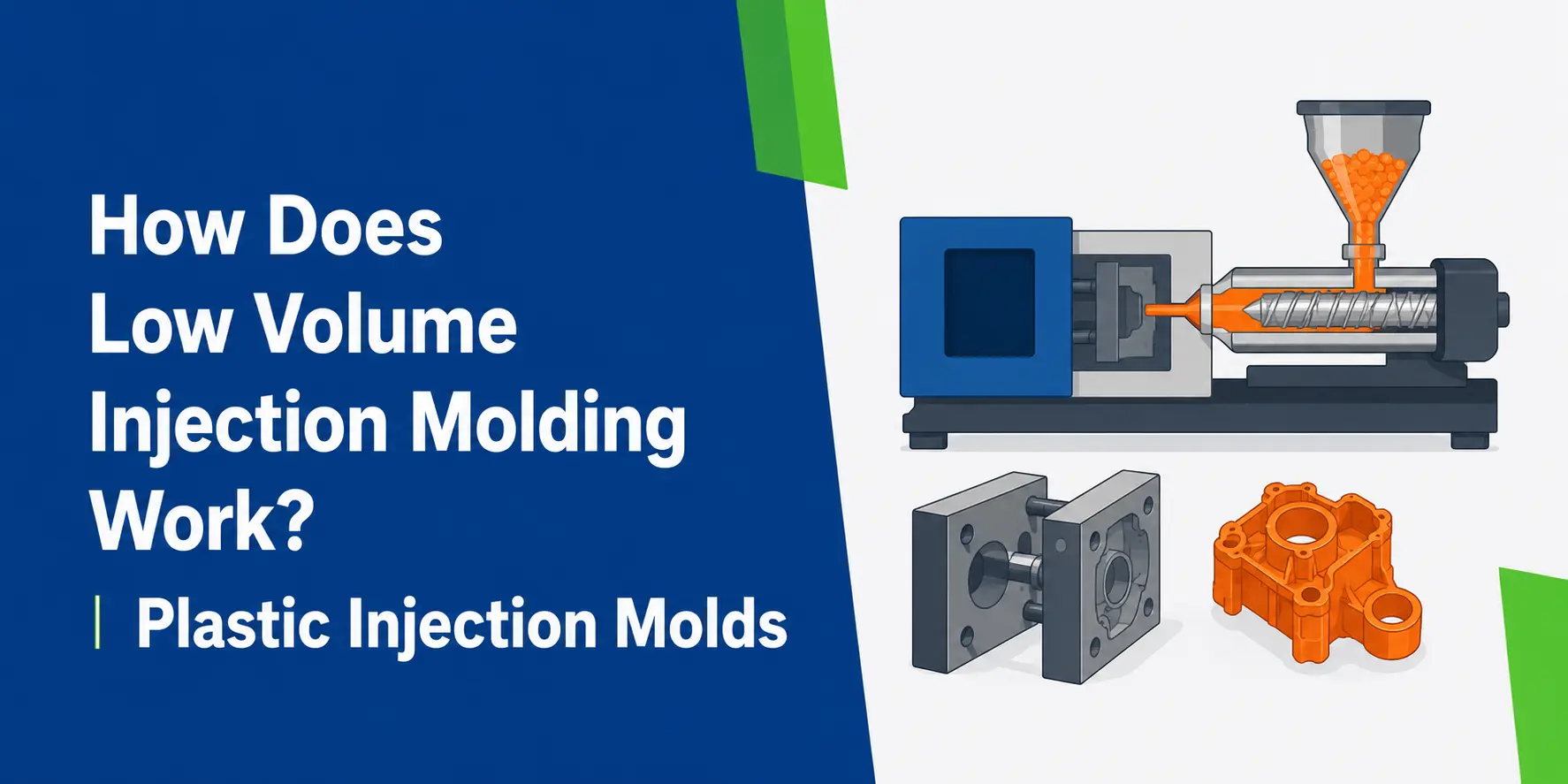
Most manufacturing methods force a choice between speed and cost. The gap is now filled by low volume injection molding. The process uses adjusted techniques to cut setup and tooling costs. It retains all of the dimensional accuracy and material consistency of full production.
The low volume injection molding is used for market testing, spare parts, custom components and pre production runs. It removes the single biggest barrier that stops new products reaching the market.
This process follows five distinct and consistent stages from start to finish.
Step 1: Design Validation
We first conduct a full CAD file review and analysis. We select appropriate materials based on final part requirements.
The wall thickness is optimised to prevent warping and reduce cycle time. Draft angles are adjusted to ensure clean and consistent ejection of every part. Gate placement is planned to eliminate surface defects and flow lines. Most common failures in low volume injection molding originate at this stage.
Step 2: Tooling Creation
The tooling for small runs uses very different design principles. Most production tools are built from machined aluminium. Steel inserts are added only for areas that will see high wear. Cooling channels are simplified to reduce tool build time and cost.
The quick change tooling systems are integrated for future adjustment. The cavity count is kept as low as practical.
Step 3: Machine Setup
The setup procedures are modified for small batch production. Our technicians first complete full preparation of the injection unit. Each temperature zone is calibrated to the selected material. Hold and injection pressure settings are adjusted for small cavity counts.
Our cycle time is optimized to balance speed and consistent part quality. Pre-run quality check protocols are established before any material is injected. Setup time represents a much larger share of total project cost for small runs. We provide cleanroom injection molding for projects that require controlled production environments.
Step 4: Production Run
The production run begins with a full inspection of the very first shot. Process parameters are monitored continuously through the entire run. Dimensional checks are completed at regular predefined intervals.
We evaluate the surface finish against the agreed project specification. We then eject and collect the finished parts in designated sealed containers.
Step 5: Quality Control
Final quality control follows a structured process for every batch. Statistical sampling is used to select parts for full inspection. All critical dimensions are verified against the original CAD file. ISO 13485 injection molding processes follow all applicable customer projects.
The functional testing is completed where required by the project specification. All results and measurements are recorded and provided with the final order.
These two processes share no common standards or practices. Batch sizes for small runs generally fall between 10 and 10000 parts. The low volume injection molding uses aluminium tooling instead of hardened steel.
The cooling systems are simplified rather than optimised for absolute maximum speed. Ejection mechanisms are kept as simple as practical for short runs. Automation levels are reduced to provide greater flexibility during production.
|
Low Volume vs High Volume Production Comparison |
||
|
Feature |
Low Volume |
High Volume |
|
Batch Size |
10-10,000 parts |
50,000+ parts |
|
Tooling Material |
Aluminum/Hybrid |
Steel |
|
Setup Time |
2-5 days |
2-8 weeks |
|
Mold Cavities |
1-4 cavities |
8-32 cavities |
|
Cycle Time |
30-120 seconds |
15-60 seconds |
|
Tool Life |
10K-100K shots |
1M+ shots |
|
Lead Time |
1-3 weeks |
6-12 weeks |
It is the standard method for medical grade plastic parts testing and early validation. The automotive manufacturers use it for prototype and pre production parts. The aerospace companies depend on it for low demand specialist components.
The consumer electronics brands use it for market testing and initial product launches. The industrial equipment manufacturers use it for spare and replacement parts. It is also used for custom tooling and fixture applications.
Material selection has a far larger impact on small runs than most manufacturers realise. The flow characteristics change when running only one or two cavities. The shrinkage rates are much harder to predict in simplified aluminium tooling.
The temperature resistance of the final part can vary with small process changes. Chemical properties remain consistent if process parameters are held correctly. The recyclability of scrap material is much higher for small production runs. All medical grade plastic parts are produced and packaged in accordance with international standards.
The FDA approved plastic molding requires specific material selection and handling procedures.
Tooling Options for Small Batches
A wide range of different tooling options exist for small production runs.
Aluminum mold construction
This is the most common and most versatile tooling option available. It provides good part quality at a very low upfront tooling cost.
Printed inserts are used for extremely low volume runs and design iteration. They allow full design changes in less than 24 hours in most cases.
Hybrid steel aluminium builds
Hybrid tools combine aluminum bodies with steel inserts for high wear areas. They provide extended tool life at a small increase in upfront cost.
Modular tooling systems
Modular tooling allows common base plates to be reused across multiple projects. This reduces total tool cost for subsequent projects.
Rapid prototype molds
Prototype molds are built for runs of less than one hundred parts. They prioritise absolute minimum lead time over all other factors.
Bridge tooling solutions
Bridge tooling is used to fill the gap between prototyping and full production. It allows manufacturing of the production parts for permanent tooling. The cleanroom injection molding can be performed with any of these tooling types.
This process is not the right choice for every single project.
It provides lower total cost than 3D printing above 50 parts. The ISO 13485 injection molding is performed as a low volume process.
We specialise in low volume injection molding services for all industry sectors. Our company combines modern equipment with flexible production methods. Our experienced team handles every stage from design optimisation to final inspection. We are also an FDA registered plastic parts manufacturer for all suitable materials.
Every project is managed to meet exact customer specifications and requirements. Our facility features modern equipment designed specifically for small run production.
We operate as an ISO 13485 certified injection molding company for medical projects. We also provide full FDA approved plastic molding for components intended for food contact and medical use.
1. What batch sizes count as “low volume” injection molding?
Typically 10 to 10,000 parts — small enough to skip expensive steel tooling but still get production-quality results.
2. What tooling is used instead of steel molds?
Mostly aluminum, sometimes with steel inserts in high-wear spots. It's cheaper and faster to build, with tool life around 10K–100K shots.
3. How long does a low volume molding project take?
Setup usually takes 2–5 days, with total lead time of about 1–3 weeks — much faster than the 6–12 weeks typical of high-volume runs.
4. When does it make more sense than 3D printing?
Once you need more than about 50 parts, injection molding becomes more cost-effective than 3D printing while still allowing fast design changes.
5. Which industries rely on this process most?
Medical device testing, automotive prototypes, aerospace specialty parts, consumer electronics launches, and industrial spare parts all commonly use low volume molding.
Conclusion
The low volume injection molding fills a very specific need. It allows companies to order the exact number of parts. There is no requirement to commit to large volumes to access production quality.
It avoids all of the waste and risk associated with large production runs. Lead times are usually measured in weeks rather than the months required for full production. For batches of 10 to 10,000 parts, it is the best choice. It continues to grow in adoption across every major industrial sector.
Low volume injection molding makes between 10 and 10,000 finished plastic parts. It uses lower cost tooling that runs on the same standard molding machines as full production tooling. This lets you get production quality parts quickly. Call us any time at (647) 294-5240 or write to info@plasticinjection-molds.com to get pricing and lead times for your run.